
APPLICATIONS
Chemistry for Diverse Industries
Reliable chemical solutions supporting agriculture, food, pharmaceuticals, manufacturing and other industries worldwide.
Related Posts
- ▶ When should a water treatment chemical dosage be adjusted?
- ▶ When are inorganic chemicals a better fit than organic alternatives?
- ▶ How to verify batch consistency in industrial chemical raw materials
- ▶ How to qualify pharmaceutical raw materials before production approval
- ▶ How recycled content changes the performance of plastic raw materials
- ▶ How agricultural chemical prices affect seasonal purchasing plans
Send Us A Message
Pharmaceutical & Healthcare
In pharmaceutical and healthcare manufacturing, the chemical itself is rarely the only decision. A material may look suitable on a specification sheet yet create problems later through variable impurity profiles, incompatible packaging, weak traceability, or poor process fit. The practical goal is to select chemical solutions that remain reliable from development through routine production.
Pharmaceutical & Healthcare applications often depend on high-purity ingredients, specialty intermediates, solvents, excipients, disinfectants, and materials used in medical products. Each category carries different risks, but the selection logic is similar: understand the intended use, define the quality attributes that matter, and confirm that the supplier and material can support consistent use over time.
Start with the material's function, not its label
Terms such as “high purity,” “pharmaceutical grade,” or “medical grade” are useful starting points, but they do not answer whether a chemical is appropriate for a specific formulation or process. A solvent used during synthesis, for example, is assessed differently from an excipient that remains in a finished dosage form. A cleaning chemical for production equipment has different requirements from a component used in a diagnostic device.
The first question should be: Will this chemical remain in the final product, contact the product, or only support the manufacturing process? That answer affects the level of documentation, impurity control, change management, and testing needed.
- Active and functional ingredients require close control of identity, purity, impurities, and batch consistency.
- Process chemicals need to be evaluated for residual risk, removal during processing, and potential contamination pathways.
- Packaging-contact and device materials should be assessed for extractables, compatibility, and stability under real storage or sterilization conditions.
Purity is important, but impurity knowledge is more useful
A common mistake is treating a high assay value as proof of suitability. Two batches can show similar main-component purity while carrying different trace impurities, moisture levels, residual solvents, metals, or degradation products. Those small differences may affect reaction yield, product color, stability, analytical results, or biological compatibility.
For pharmaceutical and healthcare use, the useful question is not simply “How pure is it?” but “Which impurities can be present, how are they controlled, and will they matter in this process?” This is especially important for sensitive formulations, complex synthesis routes, and products with long shelf-life expectations.
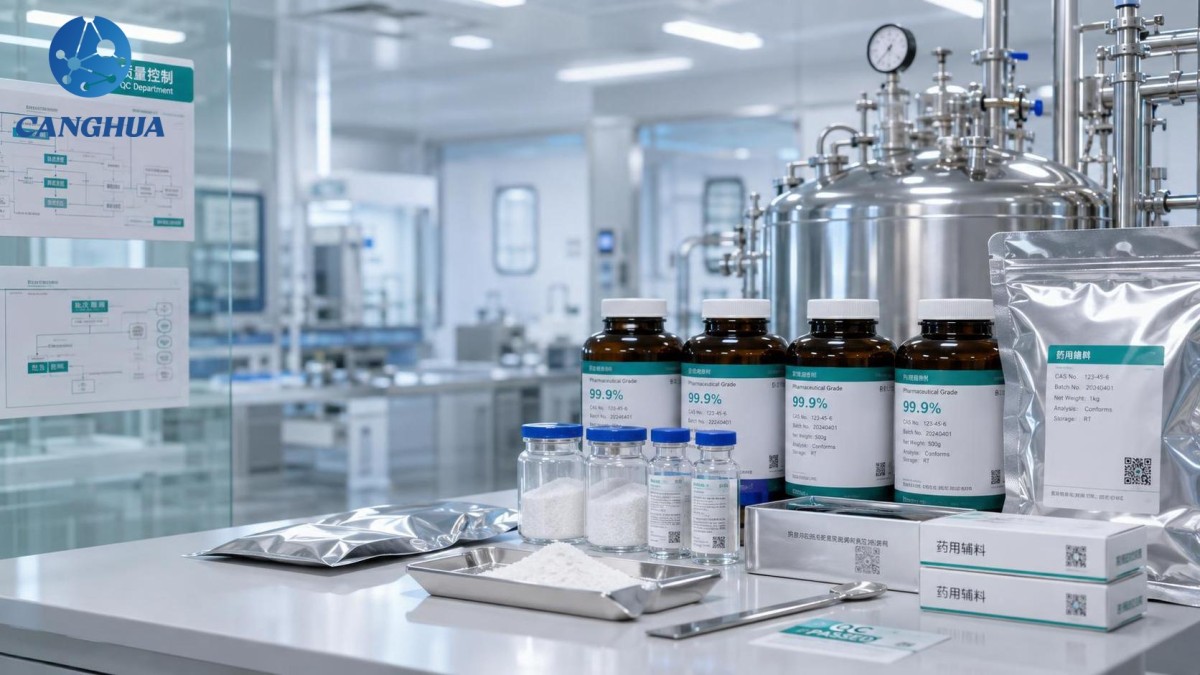
Material evaluation should therefore include a review of the certificate of analysis, test methods, lot-to-lot consistency, storage conditions, and the supplier's approach to deviations and changes. Documentation is not administrative overhead; it is what allows a manufacturer to investigate a failed batch or defend a material decision later.
Compatibility failures often appear after procurement
A chemical can meet its basic specification and still be difficult to use. Some materials absorb moisture during handling. Others react with plastics, seals, or metal surfaces. Certain solvents may affect elastomers, while powders can create dust-control, flow, or dispensing challenges. These issues are often discovered only when a material moves from a laboratory environment to larger-scale operations.
Before approving a new material, assess the full use condition: concentration, temperature, exposure time, mixing sequence, equipment surfaces, packaging format, and cleaning method. Small-scale screening is helpful, but it should reflect the intended process rather than an idealized laboratory setup.
Reliable supply includes controlled change
In regulated production, an unexpected raw-material change can be as disruptive as a quality failure. A supplier may alter a manufacturing site, raw material source, analytical method, packaging configuration, or specification range. Even when the product name remains unchanged, process performance may shift.
For this reason, pharmaceutical chemical sourcing should consider more than price and delivery time. A dependable source should provide clear lot identification, usable quality documents, consistent packaging, and a defined process for communicating relevant changes. Dual sourcing can reduce supply risk, but alternate materials should be qualified early rather than introduced during a shortage.
A practical approval sequence
- Define the chemical's exact role and the quality risks connected to that role.
- Identify critical properties beyond assay, such as moisture, particle characteristics, trace contaminants, or residual components.
- Review available documentation and determine whether it supports internal quality and traceability needs.
- Test compatibility with the actual formulation, equipment, packaging, and cleaning process.
- Establish incoming checks, storage controls, and a procedure for evaluating supplier changes.
Better pharmaceutical and healthcare outcomes do not come from choosing the most heavily marketed chemical solution. They come from matching the material to its real function, understanding the failure modes around it, and building enough control into sourcing and processing to keep quality stable when conditions change.