
APPLICATIONS
Chemistry for Diverse Industries
Reliable chemical solutions supporting agriculture, food, pharmaceuticals, manufacturing and other industries worldwide.
Related Posts
- ▶ When should a water treatment chemical dosage be adjusted?
- ▶ When are inorganic chemicals a better fit than organic alternatives?
- ▶ How to verify batch consistency in industrial chemical raw materials
- ▶ How to qualify pharmaceutical raw materials before production approval
- ▶ How recycled content changes the performance of plastic raw materials
- ▶ How agricultural chemical prices affect seasonal purchasing plans
Send Us A Message
Food & Feed
Food and feed chemicals sit at the point where formulation choices become safety, shelf life, animal performance, and market access. For manufacturers and buyers, the practical question is rarely whether an ingredient can deliver a technical effect. It is whether that effect can be achieved consistently within the applicable food or feed rules, the intended process conditions, and the final product specification.
A preservative that performs well in a beverage may be unsuitable for a dry blend. A mineral source with acceptable declared purity may still create dosing, segregation, or bioavailability issues in feed. The same chemical family can therefore have very different commercial value depending on its grade, particle properties, formulation compatibility, and documentation.
Grade designation is only the starting point
“Food grade” and “feed grade” are useful commercial labels, but they should not be treated as complete qualification decisions. Buyers need to connect the ingredient specification to the actual application: intended use level, processing temperature, moisture exposure, pH, storage duration, and the destination market's requirements.
For food applications, attention often centers on identity, purity, permitted use, carry-over considerations, allergen controls, microbiological suitability where relevant, and traceability. In feed, the assessment may extend further into nutrient contribution, contaminant limits, physical handling, stability in premixes, interactions with other ingredients, and suitability for the animal category being fed.
Documentation matters because a certificate of analysis reports a batch result, while a purchasing specification defines what the operation can reliably accept. A workable specification should identify critical limits rather than relying only on a broad product name or a generic assay value.
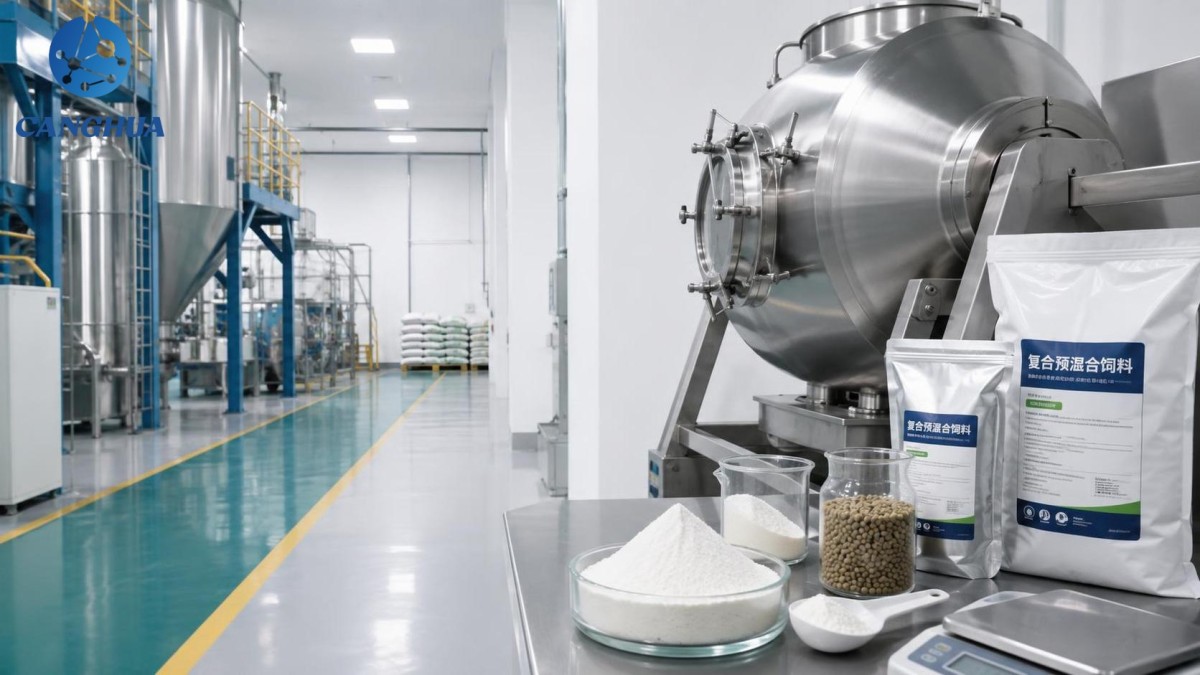
Formulation performance can change after approval
An ingredient may meet its compositional specification and still cause problems once it enters production. Acidulants can alter flavor balance and affect the behavior of hydrocolloids or proteins. Anti-caking agents can influence flowability but may change appearance or dispersion. Feed additives can react with vitamins, fats, or trace minerals during storage, especially in concentrated premixes.
These issues are often visible only after the chemical is exposed to the full manufacturing sequence. The questions to ask before switching or approving a source are therefore application-specific:
- Does it dissolve, disperse, or mix at the required production stage?
- Will its particle size and bulk density work with existing dosing equipment?
- Does it remain stable through heating, extrusion, pelleting, drying, or storage?
- Can it introduce off-notes, color changes, dusting, caking, or segregation?
- Will the declared active content remain meaningful at the point of use, not only at manufacture?
Small formulation changes can also alter regulatory status. A compound used as a processing aid, nutrient source, acidity regulator, preservative, or technological additive may be assessed differently depending on its stated purpose and the final product category. Product development, regulatory review, quality assurance, and procurement should align on this classification before commercial volumes are committed.
Supply consistency is a food and feed safety issue
Cost pressure can make an alternative supplier appear interchangeable, particularly for common salts, acids, carriers, minerals, or functional additives. That assumption is risky when process performance depends on characteristics not captured by the headline specification.
Supplier qualification should examine change-control discipline, batch traceability, packaging integrity, storage and transport conditions, contamination-control measures, and the ability to provide consistent technical documents. For imported materials, labeling, language, lot identification, and the chain of custody deserve the same attention as laboratory values.
A useful approach is to separate three decisions that are often compressed into one: whether the chemical is permitted for the intended use, whether it performs in the formula, and whether the supplier can reproduce that performance over time. Passing the first two does not automatically establish the third.
Build approval around the finished product
The strongest food and feed chemical selection process begins with the finished product's constraints, then works backward to the ingredient. Define the required function, acceptable quality range, process exposure, compliance obligations, and test method before comparing offers. Where a material has a narrow operating window, a representative production trial may be more informative than a lower quoted price.
For food and animal nutrition businesses, chemical selection is therefore less about choosing a named ingredient and more about controlling the conditions under which that ingredient delivers its intended result. The right choice is the one that remains compliant, manageable, and predictable from receiving through to the product consumed.