
APPLICATIONS
Chemistry for Diverse Industries
Reliable chemical solutions supporting agriculture, food, pharmaceuticals, manufacturing and other industries worldwide.
Related Posts
- ▶ When should a water treatment chemical dosage be adjusted?
- ▶ When are inorganic chemicals a better fit than organic alternatives?
- ▶ How to verify batch consistency in industrial chemical raw materials
- ▶ How to qualify pharmaceutical raw materials before production approval
- ▶ How recycled content changes the performance of plastic raw materials
- ▶ How agricultural chemical prices affect seasonal purchasing plans
Send Us A Message
When are inorganic chemicals a better fit than organic alternatives?
When Inorganic Chemistry Solves the More Demanding Problem
Organic chemicals are often selected for their reactivity, formulation flexibility, or compatibility with carbon-based systems. But they are not automatically the better engineering choice. Inorganic Chemicals can be a stronger fit when a process must tolerate high temperature, aggressive pH, oxidation, mineral contamination, or long storage periods without relying on complex stabilization.
For technical evaluators, the useful question is not whether a material is “organic” or “inorganic.” It is whether its chemical behavior remains predictable under actual operating conditions. A lower initial material cost can be misleading if the alternative creates corrosion, residue, treatment instability, safety controls, or repeated reformulation work later in the process.
Situations where inorganic options usually deserve priority
High-temperature applications are an obvious starting point. Many inorganic salts, oxides, silicates, and mineral-based compounds retain useful properties at temperatures where organic compounds may soften, decompose, volatilize, or produce unwanted by-products. This matters in ceramics, glass, refractory systems, metallurgy, catalyst preparation, mineral processing, and certain polymer compounding operations. Thermal stability should still be checked against the exact process temperature, residence time, atmosphere, and impurity profile; “inorganic” alone is not a guarantee.
Water treatment is another area where inorganic chemistry is often practical. Coagulants, pH-adjustment materials, oxidizing agents, and precipitation chemicals are selected because they can address suspended solids, alkalinity, hardness, metals, or phosphorus through relatively direct mechanisms. Organic treatment aids may be valuable for specific flocculation or conditioning tasks, but they can introduce concerns around dosage sensitivity, residual organics, biodegradation, or compatibility with downstream treatment. The right choice depends on raw-water variability, target contaminants, sludge handling, and local discharge requirements.
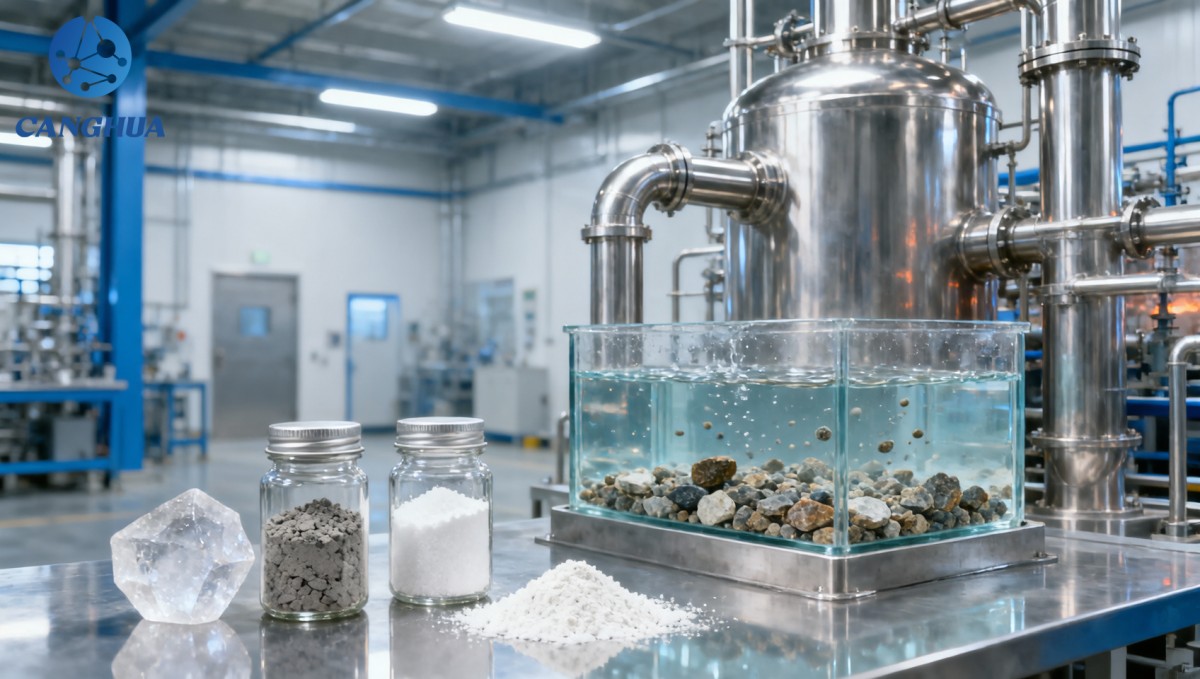
Inorganic materials also tend to be attractive when the desired function is mineral-based rather than molecularly selective. Pigments and fillers, for example, may be chosen for opacity, brightness, hardness, heat resistance, or controlled particle behavior. In catalysts, metal oxides and salts can provide activity or support functions that organic compounds cannot maintain under severe reaction conditions. In electroplating, surface treatment, and cleaning systems, inorganic acids, alkalis, and salts are frequently evaluated for their concentration stability and established process role.
The trade-offs that should not be overlooked
An inorganic alternative may bring its own complications. Strong acids, bases, oxidizers, and soluble salts can create corrosion risks for tanks, valves, pumps, or transfer lines. Some materials are hygroscopic, prone to caking, or sensitive to moisture during storage. Others may introduce ions that interfere with a coating, a polymer formulation, or a biological treatment stage. Purity, particle size, solubility, moisture content, bulk density, and trace-metal limits can therefore matter as much as the chemical name.
A sound comparison also considers the full process, not just the active ingredient. Ask whether the material changes pH, generates additional sludge, requires special packaging, or creates a different waste classification. Confirm compatibility with existing equipment and with all other formulation components. Where the material is used in regulated end applications, the relevant specification and market requirements need to be verified before final approval.
A practical evaluation path
Before switching from an organic material, or replacing an inorganic one, define the decision around the process failure you are trying to prevent. Is the concern heat exposure, unstable pH, corrosion, color variation, settling, contamination, or delivered cost? Then compare candidate materials under representative conditions rather than relying only on technical data sheets.
- Set acceptance limits for assay, insoluble matter, moisture, particle size, and relevant impurities.
- Review handling requirements, including dust control, moisture protection, corrosion-resistant contact materials, and transport classification where applicable.
- Run compatibility checks with process water, additives, substrates, and downstream treatment systems.
- Assess supply consistency: packaging format, origin, lot documentation, lead time, and the feasibility of alternative qualified sources.
For global industrial buyers, supply reliability is part of the technical decision. Shandong Canghua Chemical Co., Ltd. supports customers across chemical raw-material categories, including inorganic and organic chemicals, water-treatment materials, additives, agricultural chemicals, and plastic raw materials. In practice, useful supplier support means aligning sourcing and quality communication with the parameters that affect the customer’s process—not simply offering a broad product list.
Inorganic Chemicals are usually the better fit when durability, mineral functionality, process robustness, or cost control under harsh conditions matters more than molecular flexibility. The final choice should be confirmed through specification review and application testing, with packaging, export documentation, and delivery conditions considered early rather than after qualification.