
APPLICATIONS
Chemistry for Diverse Industries
Reliable chemical solutions supporting agriculture, food, pharmaceuticals, manufacturing and other industries worldwide.
Related Posts
- ▶ When should a water treatment chemical dosage be adjusted?
- ▶ When are inorganic chemicals a better fit than organic alternatives?
- ▶ How to verify batch consistency in industrial chemical raw materials
- ▶ How to qualify pharmaceutical raw materials before production approval
- ▶ How recycled content changes the performance of plastic raw materials
- ▶ How agricultural chemical prices affect seasonal purchasing plans
Send Us A Message
Agriculture & Fertilizers
Agriculture & Fertilizers: Chemical Choices That Shape Crop Performance
Agriculture and fertilizers are closely connected, but productive nutrient management is not simply a matter of applying more product. Growers must match nutrient forms, timing, placement, soil conditions, water availability, and crop stage. The chemical industry supports that process by supplying nitrogen, phosphate, potash, sulfur, micronutrients, stabilizers, and specialty formulations designed for different agronomic conditions.
The practical question is usually not “Which fertilizer is best?” It is “Which nutrient source can deliver the required elements with acceptable handling, compatibility, efficiency, and environmental risk on this particular farm?” That distinction matters when comparing bulk commodities with water-soluble grades, controlled-release products, foliar feeds, or blended fertilizers.
Nutrient form matters as much as nutrient analysis
Nitrogen fertilizers may contain nitrogen in ammonium, nitrate, urea, or mixed forms. Each behaves differently after application. Urea can be an efficient nitrogen source, yet surface application under certain conditions may increase the risk of ammonia loss. Nitrate is immediately plant-available but can move with water in susceptible soils. Ammonium interacts differently with soil exchange sites and can affect the root-zone environment. A fertilizer program should therefore consider local weather patterns, irrigation practice, incorporation method, and crop uptake curve rather than nutrient percentage alone.
Phosphate selection also requires care. Phosphorus is essential for early rooting and energy transfer, but its availability can be limited by soil chemistry. In many situations, placement near the root zone is more relevant than applying a large amount broadly. Potassium, sulfur, calcium, magnesium, zinc, boron, iron, and manganese add another layer of complexity. A micronutrient may be needed in a very small quantity, but poor compatibility or unsuitable pH can still make an otherwise sound plan ineffective.
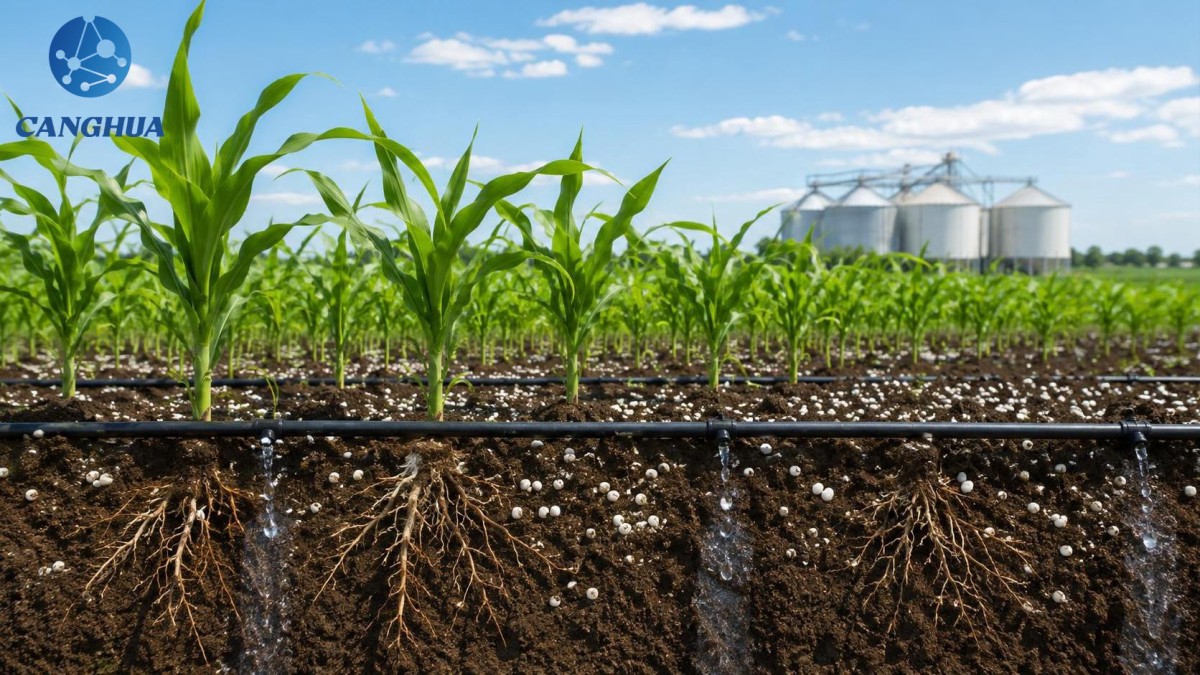
Choosing between conventional, specialty, and blended fertilizers
Conventional granular and liquid fertilizers remain central to large-acreage farming because they are familiar, widely handled, and suitable for broad nutrient programs. Their value depends on consistent nutrient content, physical quality, storage stability, and reliable delivery. For distributors and farm operators, caking, dust, moisture sensitivity, segregation in blends, and corrosion exposure are not minor operational details; they can affect application accuracy and safety.
Specialty fertilizers are often considered where nutrient-use efficiency, fertigation, foliar correction, or precise crop-stage feeding is a priority. Water-soluble products may be appropriate for irrigation systems, but water quality and tank compatibility should be checked before mixing. Controlled-release materials can help align nutrient availability with crop demand in some applications, although their behavior depends on temperature, moisture, and coating design. They should not be treated as a universal substitute for agronomic planning.
- Confirm the nutrient analysis in the form required by local labeling and crop recommendations.
- Check blend compatibility, especially when micronutrients, phosphates, and liquid materials are involved.
- Assess storage conditions, including humidity, temperature variation, packaging, and segregation requirements.
- Review application equipment calibration before attributing uneven crop response to fertilizer quality.
Efficiency begins with soil and application decisions
Fertilizer chemistry can improve nutrient delivery, but it cannot compensate for missing field information. Soil testing, tissue analysis where appropriate, realistic yield expectations, and field history provide the basis for deciding what to apply. Soils with variable texture, drainage, organic matter, or pH may require zone-specific decisions rather than a single farm-wide blend.
Application timing deserves equal attention. Nutrients applied too early may be exposed to loss pathways before the crop can use them; nutrients supplied too late may not correct a deficiency in time. Split applications, band placement, fertigation, inhibitors, and coated products are tools—not guarantees. Their suitability depends on the crop system and should be evaluated against handling cost, labor, equipment capability, and local environmental requirements.
What is changing in fertilizer chemistry
Current development in agriculture & fertilizers is moving toward more precise nutrient delivery, improved compatibility in blends, lower-loss nitrogen management, and products that fit modern irrigation and precision-application systems. Interest is also growing in recycled nutrient sources and formulations designed to support soil health strategies. Performance claims in these areas should be reviewed carefully: crop response can vary with soil, climate, management, and the quality of the underlying agronomic program.
A sound fertilizer decision starts with the crop’s nutrient demand, then works backward through soil conditions, application method, product chemistry, logistics, and regulatory obligations. Before finalizing a program or supply specification, it is worth confirming nutrient form, impurity limits where relevant, physical properties, packaging, transport conditions, and the standards applicable in the destination market.
- Last One:Water Treatment & Environmental2026-09-07
- Next Article:No more articles